
Why Biblical Theology Must Shape our Teaching
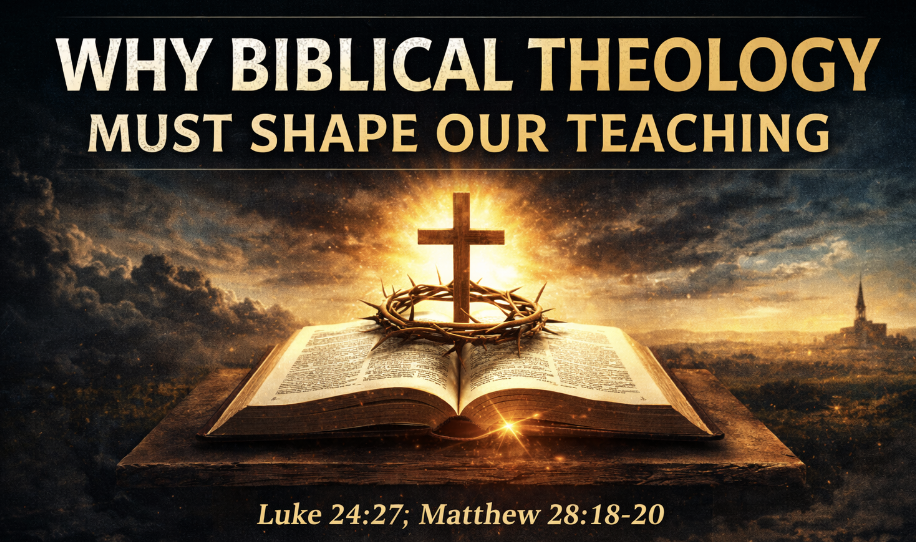
“And beginning with Moses and all the Prophets, he interpreted to them in all the Scriptures the things concerning himself.”
— Luke 24:27 (ESV)
Before the church ever preached a sermon in Acts, before the apostles organized anything, before a single epistle was written, Jesus gave a Bible study. And it was not random.
On the road to Emmaus, two discouraged disciples are trying to make sense of recent events. They know the facts. They know the headlines. But they do not understand the story.
So Jesus opens the Scriptures. Not one passage. Not one moral example.
“All the Scriptures.”
Moses. The Prophets. The whole covenantal sweep.
And Luke tells us that He interpreted all of it as concerning Himself.
That moment establishes more than comfort. It establishes method. It reveals how Scripture is meant to be read and, therefore, how it must be taught.
If Christ Himself reads the canon as a unified redemptive witness, then faithful teachers must do the same.
Biblical theology is not an academic luxury. It is the grammar of faithful teaching.
The Unity of Scripture and the Redemptive Story
Jesus did not treat the Old Testament as a collection of disconnected moral tales. He treated it as a coherent testimony moving toward fulfillment. That is the heartbeat of biblical theology.
Biblical theology traces the theological message of the whole Bible. It follows the unfolding of promise, covenant, kingdom, temple, priesthood, exile, restoration—and sees their convergence in Christ.¹ This approach guards us from fragmentation.
Without it, David becomes merely an example of courage. Joseph becomes a model of integrity. Nehemiah becomes a leadership template.
But Scripture is not primarily about heroic individuals to imitate. It is about the redemptive work of God advancing through covenant history toward Christ and ultimately toward the renewal of all things.
As Köstenberger and Goswell argue, biblical theology reads texts within the canonical shape that God Himself has given.² The parts are interpreted in light of the whole. The whole is interpreted in light of Christ.
When teachers lose this canonical awareness, they may still be biblical—but they are no longer biblical in a redemptive-historical sense. And over time, that loss reshapes the church.

Teaching Under Christ’s Authority
The Great Commission reinforces this structure:
“All authority in heaven and on earth has been given to me. Go therefore… teaching them to observe all that I have commanded you.”
— Matthew 28:18–20 (ESV)
Notice the order.
Authority first.
Teaching second.
Teachers are not meaning-makers. They are stewards. They do not stand over Scripture but under it. The message is received before it is delivered.
Biblical theology strengthens that posture of submission. It reminds us that the story did not begin with us. We have inherited a canon shaped by divine intention.
Gladd’s work on covenant continuity shows that the people of God—from Adam to Israel to the church—are formed through this unfolding redemptive structure.³ That continuity demands theological care. Teachers must ask not only what a text says, but where it stands in the story.
When teaching detaches itself from the redemptive arc, authority subtly shifts. It moves from Scripture’s structure to the teacher’s creativity. And that is a dangerous exchange. The canon restrains the ego. That restraint is not a burden. It is protection for both teacher and hearer.
The Danger of Fragmented Teaching
Fragmentation rarely begins with rebellion. It begins with urgency.
A cultural issue needs addressing.
A leadership principle seems helpful.
A practical topic feels relevant.
None of these are wrong. But when texts are lifted from their canonical context and pressed into service without redemptive grounding, the church slowly learns to read the Bible in pieces.
Goldingay emphasizes that biblical theology seeks the theological message of the whole Christian Scriptures.⁴ Without that whole, theology becomes thin and application becomes disconnected.
Fragmented teaching produces:
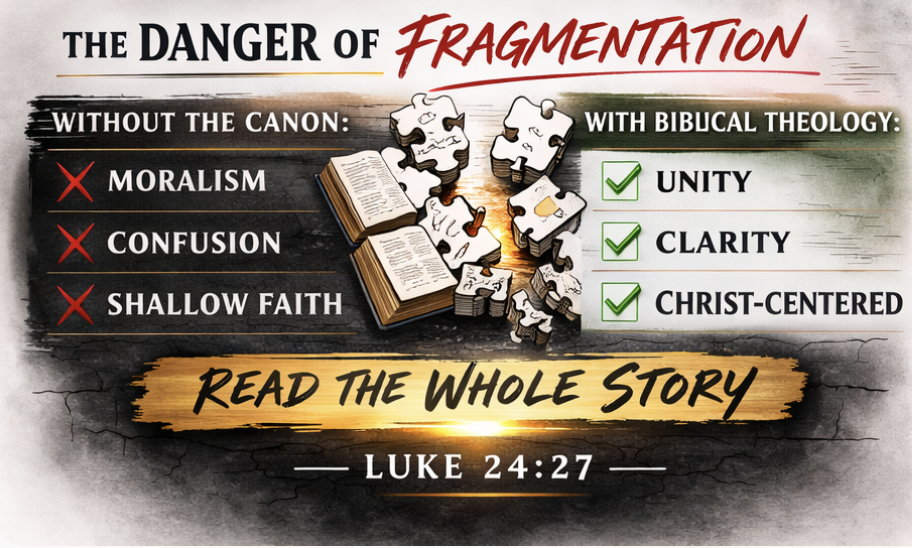
Moralism without redemption.
Application without covenant context.
Inspiration without incarnation.
Activity without transformation.
Over time, believers may know verses but not the story. They may memorize commands but miss the covenant. They may quote Scripture yet struggle to see Christ as its center. Jesus warned against this in John 5:39. Scripture testifies about Him. To read it otherwise is to miss its aim. Biblical theology guards that aim.
Formation Through the Canon
Faithful teaching is not merely about information transfer. It is about formation.
Paul’s ministry vision in Colossians 1:28 is to present everyone mature in Christ. That maturity does not arise from isolated insights. It arises from immersion in the redemptive story.
Senkbeil reminds pastors that ministry flows from patient submission to the Word rather than from cultivated persona.⁵ That patience is deeply pastoral. It trusts that God forms His people through the steady unfolding of His revealed purposes.
When teachers commit to biblical theology, they commit to teaching within the architecture of redemption. They resist the temptation to center the self, whether as hero or victim. They resist building ministries on charisma rather than canon.
They allow Scripture’s unity to shape both content and tone.
And that kind of teaching produces depth.
Returning to the Whole Counsel of God
On the road to Emmaus, Jesus did not offer a quick fix. He offered a canonical lens.
He interpreted “all the Scriptures” as concerning Himself. That moment sets the standard. Biblical theology:
Preserves the unity of Scripture.
Anchors teaching in covenant continuity.
Centers Christ in the canon.
Guards against fragmentation.
Forms the church within the redemptive story.
If we want churches shaped by the Word rather than by platforms, we must train teachers to handle the whole counsel of God.
In the next post, we will move from the macro-framework of biblical theology to the disciplined work of reading texts carefully in their historical and literary context.
Because if the story is unified, our handling of each text must reflect that unity.
Endnotes
John Goldingay, Biblical Theology: The God of the Christian Scriptures (Downers Grove, IL: IVP Academic, 2016), 3–8.
Andreas J. Köstenberger and Gregory Goswell, Biblical Theology: A Canonical, Thematic, and Ethical Approach (Wheaton, IL: Crossway, 2023), 17–25.
Benjamin L. Gladd, From Adam and Israel to the Church: A Biblical Theology of the People of God (Downers Grove, IL: IVP Academic, 2019), 1–12.
Goldingay, Biblical Theology, 10–14.
Harold L. Senkbeil, The Care of Souls: Cultivating a Pastor’s Heart (Bellingham, WA: Lexham Press, 2019), 41–47.